
Last week, a news headline caught my attention: “Gen Z: the first generation with a lower IQ than the previous one”. I became curious, and the details of a recent study reveal that, for the first time in modern history, Generation Z (born between 1997 and 2010) is recording IQ scores lower than those of Millennials.
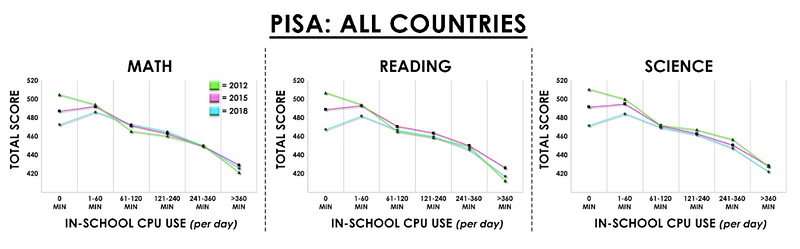 |
| The relationship is monotonic: more screen time, lower performance. |
For decades, humanity followed the so-called “Flynn Effect,” a rule stating that each generation was born more intelligent than the previous one. But it seems the game has changed. The decline is not an isolated case, but a global trend across more than 80 countries that began around 2010, a period that coincides with the arrival of smartphones and tablets in classrooms.
The most expressive change is in reading. To keep Gen Z focused, comprehension tests that once used 750-word texts were reduced to just 75. To give an idea, children who used screens for only five hours a day, specifically for their studies, scored lower than those who rarely or never used technology in the classroom.
The most curious part is that the generation with the greatest access to information is becoming the least intelligent. In the end, the ease of the internet and AI may lead young people to a dangerous future.
On the other hand, young adults, with far more ways to connect, are becoming increasingly anxious, depressed, and dependent on medication, whether to balance brain chemistry or to lose weight and fit into a supposed aesthetic standard — even if it costs the health of their internal organs — as seen in the trend of weight-loss injection pens.
 |
| Photo by ilgmyzin on Unsplash |
To make matters worse, food delivery apps, dating apps, transportation apps, social media, and robots that summarize texts and write for us spare us from a large portion of cognitive work and physical “effort” to obtain whatever we want. The psycho-comparison that used to be only with your neighbor is now with a network of hundreds of people, where even the number of hours slept has become a status symbol. A context that, at first glance, seemed controlled and ideal in an increasingly busy, accelerated, and connected world.
For a long time, I had a prejudice against some coaches and conversations like “work while they sleep,” which can be harmful, although I still understand that meritocracy is not something to be taken seriously when everyone’s starting point is so different. However, the other extreme is equally damaging: passivity. We cannot expect to be here only to enjoy comfort without going through moments of pain and learning.
There is no growth without pain.
Avoiding discomfort and situations that require us to be bigger and better is simply a way of avoiding growth. In practice, avoiding reading a more complex text and freezing in the face of the challenge of becoming a learner when trying something new is a sin against thousands of years of evolution that have allowed us to become who we are today and to build things as powerful as AI itself.
Technology arrived faster than we had time to prepare society for it, as has always been the case. However, there is still hope that studies like this serve as a motivator and a reminder of the beauty of being a lifelong learner, as the Brazilian composer Gonzaguinha said in 1982. For example, I remember when I, still an undergraduate student, truly learned how to write, understand algorithms, and solve complex logic problems for a beginner at the time, such as teaching a program to calculate a simple Fibonacci sequence. I still remember the gratifying feeling of realizing that my brain made the necessary connections for me to understand. It is from this resilience that we cultivate hope and learn to find peace and beauty in discomfort — something practicality and convenience cannot buy.
This applies to many other situations in life. The secret is not to seek a comfortable life without conflicts, but to learn to find peace (or at least clarity of thought and drive) in discomfort. It is not about avoiding conflicts, but learning how to deal with them without losing yourself. Being at peace is different from being passive, from simply accepting everything that seems convenient. When such important lessons are ignored, life charges its price.
 |
| Photo by Josué Soto on Unsplash |
This situation reminds me of how I have always admired the journey of sea turtles, from hatching to their journey toward the ocean. Instinctively, they know that if they remain in the comfort of the eggs and do not face the discomfort and fear of the unknown toward the sea, they will become easy prey for other reptiles and birds. When we stop and observe nature (that is, ourselves as part of it), we see that evolution does not happen through fear.
We are the result of millions of years of evolution, in which we had to deal with the unknown and the uncontrollable. We must learn to adapt to the unpredictable and to find paths even without having access to all the information. We developed our instincts, sharpened our senses, learned from nature, and survived because we learned to observe it and to be patient, respecting the timing of each process — not by receiving a 40-second trailer explaining how everything works.
So even when the next step feels uncomfortable, remember that life and your evolution require movement and time to happen.
0 Comments