

Still, something made me pause and reflect last week while talking with my girlfriend. Phrases like these, although well-intentioned, often sound tense — charged with a subtle sense of friction. And to be clear, I’m not talking about clearly abusive situations — those involving harassment, invasion, or violence — where saying no firmly is absolutely necessary (something many women understand far better than I do).
I’m talking about something that starts much earlier than that.
And it starts within us.
A phrase like “you need to set boundaries” often hides what we truly need to practice: respecting ourselves in order to respect others.
Over nearly half a decade of therapy (a privilege, I know) my therapist helped me understand something that deeply changed how I see relationships: respect is love, and love is respect. Not only love for others, but also love for oneself.
When I truly understood that, everything changed.
Even for those with a religious background, it’s worth recalling when Jesus said: “Love your neighbor as yourself” (Mark 12:31; Matthew 22:37–39). That “as yourself” is not a detail — it’s essential. And I don’t say this in a selfish way, but because, in practice, we can only love others to the extent that we love and respect ourselves. Including when we need to move forward… or when we need to walk away from certain situations.
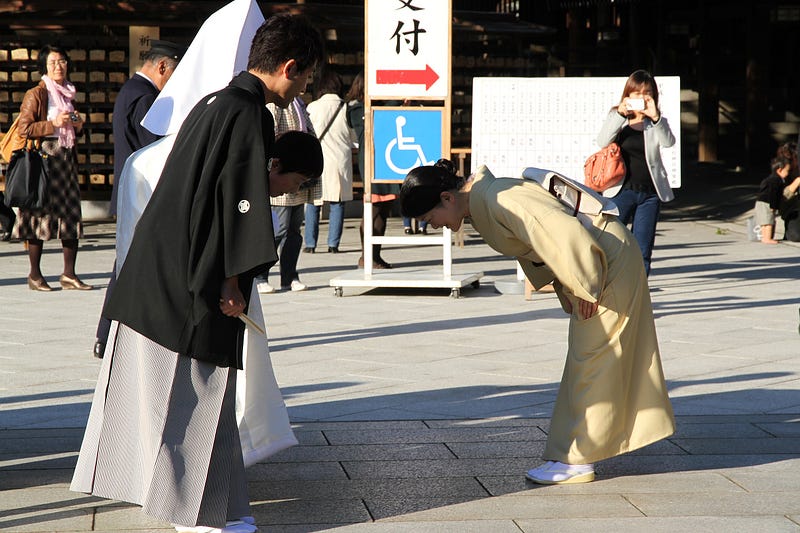 |
| People bowing in Japan on Wikipedia |
In the West, however (and unfortunately) the word respect, when used out of context, can sound like an affront or an imposition: “I demand respect.” But often, saying that is equivalent to saying: “I demand love.” And no one can offer what they do not have.
When I learned that respecting myself is loving myself, I also learned that I cannot demand respect from anyone. What I can — and must — do is find respect within myself: for my origins, my wounds, my dreams, and for every minute of life I’m lucky enough to breathe. And to stay close, in whatever way possible, to people who respect me for who I am.
Here lies the inflection point: many times, you don’t need to set boundaries. What we truly need is to respect ourselves — deeply and honestly.
Boundaries then emerge naturally, without effort, without forced confrontation.
This applies to friendships, relationships, and work. When we respect our time and our effort, even situations that seem absurd take on a different meaning: a boss who fails to recognize your work, even when you know you gave your best; someone who insults you in traffic, even when you made an unintentional mistake; or a relationship in which betrayal occurred.
In such cases, the apparent disrespect from the other says far less about you and far more about their inability, at that moment, to respect themselves — to love themselves. Or about how disconnected they are from themselves, to the point of not realizing that by disrespecting you, they are also emptying themselves of value.
As Plato and Socrates pointed out long before us, this touches directly on the concept of virtue.
Virtue, in this sense, is a way of living that enables human beings to act with goodness. It exists in balance, in the reasonable middle ground between extremes. When I act against my values, I do not act with goodness. And if I do not act with goodness, I cannot truly be happy.
So the next time you feel the urge to impose boundaries, ask first:
Am I respecting myself? Am I aware of my virtues?
Start with yourself.
The boundaries will come — naturally (whether through others, or through your own choices).
0 Comments